Today, as some of you may know, is the birthday of C.S. Lewis. Although long departed, it is an occasion still worth celebrating. Here is my humble bio
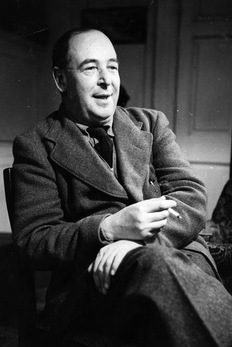
Name: Clive Staples Lewis
Pseudonyms: Clive Hamilton, N.W. Clerk
Birth Date: November 29, 1898
Place: Belfast, Ireland
Death Date: November 22, 1963
Place: Oxford, Oxfordshire, England
Best Known Works: Mere Christianity, The Chronicles of Narnia, Surprised by Joy
Clive Staples Lewis, known as Jack by his family and friends, was born in Belfast, in what today is part of Northern Ireland. His parents were both well educated and reading was a big part of his young life. At the age of three he was already able to read. Later in life, he remembered his childhood home being crammed with books. “There were books in the study, books in the drawing room, books in the cloakroom, books (two deep) in the great bookcase on the landing, books in a bedroom, books piled high as my shoulder in the cistern attic, books of all kinds…”
As he grew older he read the works of Nesbit, Doyle, Longfellow, and Twain, but it was Beatrix Potter who first inspired him. As a five year old he loved her books, which were being published around that time. He even started writing a series of fantasy stories about his own talking animals.
Lewis had a secure, blissful early childhood, which was shattered in 1908 by the death of his mother. His father was seldom around and she was the only parent he felt attached to. Just before her passing, she gave both of her sons a signed Bible. Rather than be comforted by this, ten year old Lewis blamed God for his mother’s death and by 1912 was a stubborn atheist.
During his early years he was homeschooled, but when he reached the proper age his father sent him and his brother to boarding school in England. His experience during these years was one of loneliness and unhappiness. Thankfully, in 1914 he was sent to Surrey to be tutored by a man named William T. Kirkpatrick for the last few years of his education.
Nicknamed “The Great Knock”, Kirkpatrick was a good teacher and Lewis excelled under his tutelage. He was a firm atheist and encouraged his pupil’s rejection of religion. Nevertheless, he and his wife provided Lewis with a decent home and a sound education. In 1916 he won a scholarship in classics at University College and a year later made it into Oxford.
C.S. Lewis was nineteen when he went to Oxford and lived within the grounds for the next forty-five years. He never left it again after his return from combat during WWI, except for short visits to Ireland and walking holidays with his friends. The environment suited him perfectly and after his graduation he stayed on as a professor. Even after he started work at Cambridge he did regular commutes back and forth. He lived there until his death.
During the spring of 1916, young Lewis read Phantastes by George MacDonald. The book both inspired and intrigued him. Its approach to fantasy and its glimpse into a Christian worldview were unlike anything he had read before. The impact was long lasting and he later claimed to have quoted MacDonald in every one of his books. At college he read the works of G. K. Chesterton who, like MacDonald, challenged his beliefs.
For years, Lewis and his friend Owen Barfield had debates about philosophy and religion. These discussions eventually led Lewis to accept the idea of a spiritual world. In 1932 his brother, Warren, returned to his previously abandoned faith. That summer the brothers went to church together after years of neglect.
A month later, in September, two of Lewis’s friends, Hugo Dyson and J.R.R. Tolkien engaged him in a discussion on ancient pagan beliefs and mythology. They argued that the similarities between these and the story of Christ proved that even the pagans had some grasp on the truth. Just a couple days later Lewis admitted, “I have just passed on from believing in God to definitely believing in Christ.”
With a newfound passion for his faith and his writing (he had previously published some poetical works that were met with moderate approval) he launched into three decades of crafting books, all heavily influenced by his faith. In addition to his theological works he also produced academic books, many of which are still read in University classes. In 1938 he published his first novel, Out of the Silent Planet. It was the first of his successful Space trilogy and was intended to draw in a non-Christian audience, while also weaving in elements of Christianity.
During the Second World War he spoke in a series of BBC radio broadcasts. Later these talks were written down and published as his book Mere Christianity. He also gave theological lectures to Royal Airforce crews. Ever active, Lewis even found time to meet with the Inklings, a group of Oxford men who met regularly to discuss and share their writing. Along with Tolkien, Lewis was among the most frequent attendants.
Between 1950 and 1956, C.S. Lewis published the seven books of his children’s fantasy series, The Chronicles of Narnia. These books, although met with criticism among the Oxford academia, launched him into worldwide popularity and continue to delight readers to this day. This started a constant stream of fanmail from readers, which he dutifully answered personally.
Among his correspondents was Joy Davidman Gresham, a Jewish American from New York City. As a newly baptized Christian, she began sending him letters with questions regarding the faith. Following her divorce she moved to London, where the two met and became good friends. She had difficulty supporting herself and her two sons and it was only because of Lewis’s generosity that she was able to make ends meet. Mutual respect grew to love and in 1956 they were married.
It was a happy marriage, but one met with disapproval. Lewis’s friends objected to him marrying a divorced woman and were suspicious of her previous support of Communism. Four years after they married, Joy died of cancer, at the age of forty five. The pain he experienced following her death led Lewis to write his book, A Grief Observed.
Lewis continued to care for Joy’s two sons and to work as a professor and author. He wrote his last book, Letters to Malcolm: Chiefly on Prayer, and four months before his death, retired from his position at Cambridge. He died in 1963 and was buried at a church near his home.
Clive Staples Lewis’s popularity only increased after his death. His books continue to make an impact on both the Christian and secular world. The first book in the Chronicles of Narnia, The Lion, the Witch and the Wardrobe, was listed by Time Magazine as one of the top 100 English novels of the 20th century. Over one hundred million copies of this children’s fantasy series have been sold. His theological works have continued to help and inspire Christians from all over the world; there has been none like him since.
 MSG Writing's
wow. Either you are a genius, or you spent an impressively long time on this! It’s written super well too!
LikeLiked by 1 person
Thank you! I wrote it in two days actually, haha, for a school project
LikeLike
Very well written. An honorable (or honourable?) tribute.
LikeLiked by 1 person
Thanks!
LikeLike
This, Emma, is a wonderful eulogy to the Professor. I did not know most of the things about his life, other than his books. Thanks for the lesson!
LikeLike
Np! Thank you
LikeLike